












Acne
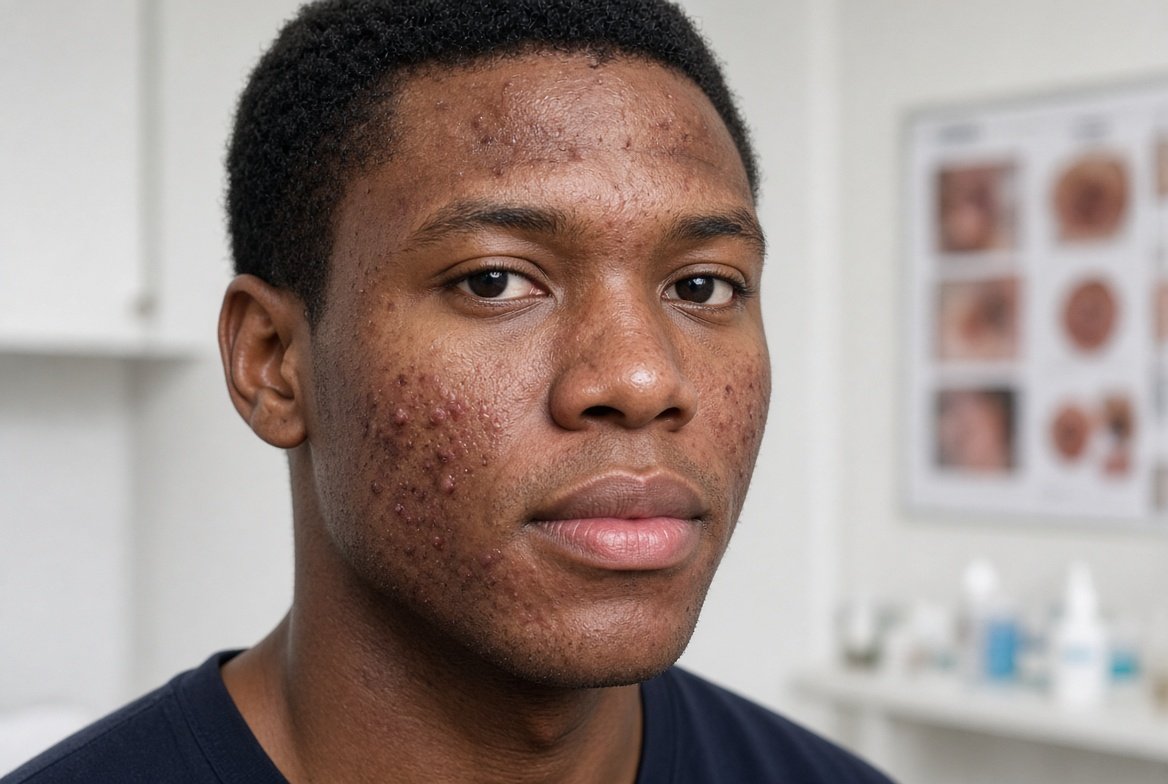
Acne vulgaris is a chronic inflammatory disease of the pilosebaceous unit. It presents with comedones, inflammatory papules, pustules, nodules and scarring on the face, chest and back.
Pathophysiology. Four processes interact: androgen driven sebum production, follicular hyperkeratinisation with microcomedone formation, colonisation by Cutibacterium acnes, and innate immune inflammation. Insulin and insulin like growth factor 1 signalling amplify sebum output. Evidence linking diet to acne is limited, although high glycaemic load diets and skimmed milk have been associated with worse disease.
Lesion types. Open and closed comedones are noninflammatory. Papules and pustules are superficial inflammatory lesions. Nodules are deep inflamed lesions over 5 mm that heal with scarring. Sinus tracts and cysts mark conglobate disease.
Severity. Mild disease is mainly comedones with a few papules and pustules and no nodules. Moderate disease has many papules and pustules with some nodules. Severe disease has numerous nodules or cysts, extensive truncal involvement, scarring or marked psychological distress. A global severity score of 0 to 4 tracks response.
Temporal pattern. Onset is at puberty, with a peak at 15 to 19 years. Persistent acne continues beyond 25 years. Late onset acne starts after 25 years, mostly in women, with a jawline and perioral pattern and premenstrual flares.
Skin of colour. Postinflammatory hyperpigmentation and keloid scarring are common and often distress patients more than the active lesions, so early control of inflammation matters.
Key distinctions. Uniform pustules appearing over days suggest steroid induced acne. Acne with hirsutism and menstrual irregularity suggests androgen excess. Acne between 1 and 7 years of age needs endocrine evaluation. Sudden ulcerating nodular acne with fever and joint pain defines acne fulminans.
History
- Age at onset, duration, flares, scarring, and previous treatments with dose, duration, adherence and response.
- Menstrual cycle, irregular periods, hirsutism, scalp hair thinning, weight gain, infertility, pregnancy plans and current contraception.
- Drugs: topical or systemic corticosteroids, anabolic steroids, testosterone, danazol, androgenic progestogens, lithium, phenytoin, phenobarbital, isoniazid, EGFR inhibitors, ciclosporin, azathioprine and high dose vitamin B12.
- Cosmetics, hair oils and pomades, skin lightening creams containing potent corticosteroid, occupational exposure to oils and chlorinated hydrocarbons, and friction from helmets, straps or sports gear.
- Mood, anxiety, sleep, body image, bullying, self harm thoughts and substance use. Ask directly, because both severe acne and isotretinoin carry psychological risk.
- Family history of severe acne, polycystic ovary syndrome, diabetes and keloid.
- Liver disease, hyperlipidaemia, alcohol use and smoking before any systemic treatment.
Examination
- Lesion types and counts on face, neck, chest, back and upper arms. Scars (ice pick, boxcar, rolling, hypertrophic, keloid), postinflammatory pigmentation and seborrhoea.
- Androgen excess: hirsutism, male pattern hair loss, clitoromegaly, deep voice, acanthosis nigricans and central obesity.
- Cushing syndrome: plethoric face, striae, proximal weakness and bruising.
- Blood pressure and body mass index.
- Mimics: uniform follicular pustules (steroid or Malassezia folliculitis), perioral papules, flushing and telangiectasia (rosacea).
- Acne fulminans: fever, arthralgia, bone tenderness and hepatosplenomegaly.
Red flags
- Sudden onset ulcerating nodular acne with fever, arthralgia, myalgia, weight loss or hepatosplenomegaly (acne fulminans).
- Rapid onset acne with virilisation, or total testosterone over 5 nmol/L (androgen secreting tumour).
- Acne between 1 and 7 years of age, or acne with early pubic hair, rapid growth or advanced bone age.
- Depression, suicidal thoughts or self harm.
- Pregnancy or possible pregnancy in a patient who needs systemic treatment.
- Pustular flare after prolonged antibiotic use (Gram negative folliculitis).
- Bone or joint pain with acne (SAPHO syndrome).
Special groups
- Preadolescents (7 to 12 years): comedonal acne is the usual first sign and responds to a topical retinoid.
- Women: premenstrual flares, a jawline pattern and polycystic ovary syndrome are common.
- Pregnancy and breastfeeding: avoid topical and oral retinoids, tetracyclines, spironolactone and cyproterone acetate.
- Skin of colour: irritation from treatments worsens pigment, so introduce retinoids and benzoyl peroxide slowly.
- Region specific: skin lightening products (corticosteroid or mercury containing), heavy hair oils, hot humid climates, and HIV associated eosinophilic folliculitis.
Acne variants
- Acne vulgaris (comedonal, papulopustular, nodular).
- Acne conglobata.
- Acne fulminans.
- Neonatal and infantile acne.
- Mid childhood acne.
- Late onset and persistent adult acne.
- Acne mechanica.
- Acne excoriée.
- Acne cosmetica and pomade acne.
- Chloracne.
- SAPHO syndrome.
Secondary and drug related acne
- Steroid acne from topical or systemic corticosteroid.
- Anabolic steroid and testosterone acne.
- Drug acneiform eruption (lithium, phenytoin, isoniazid, EGFR inhibitors, ciclosporin).
- Polycystic ovary syndrome.
- Nonclassic congenital adrenal hyperplasia.
- Cushing syndrome.
- Androgen secreting ovarian or adrenal tumour.
- Hyperprolactinaemia.
- Acromegaly.
Mimics
- Rosacea, papulopustular.
- Perioral dermatitis.
- Staphylococcal folliculitis and sycosis barbae.
- Gram negative folliculitis.
- Malassezia folliculitis.
- Demodex folliculitis.
- Eosinophilic folliculitis in HIV.
- Pseudofolliculitis barbae and acne keloidalis nuchae.
- Seborrhoeic dermatitis.
- Keratosis pilaris.
- Milia and sebaceous hyperplasia.
- Facial angiofibromas of tuberous sclerosis complex.
- Flat warts, molluscum contagiosum and syringomas.
- Hidradenitis suppurativa.
- Secondary syphilis, pustular form.
- Miliaria.
Step 1. Diagnosis and grading. The diagnosis is clinical. Record lesion counts, scars, pigmentation and psychological impact at baseline for comparison.
Step 2. Triggers. Review drugs, steroid and lightening creams, cosmetics and occupational exposures.
Step 3. Hormonal tests when there is sudden onset, severe or refractory disease, irregular menses, hirsutism, hair loss, virilisation, or onset in childhood.
- Total testosterone, sex hormone binding globulin, free androgen index, DHEAS, androstenedione, 17 hydroxyprogesterone (early morning, follicular phase), LH, FSH, prolactin and TSH.
- Total testosterone over 5 nmol/L or DHEAS over 18 micromol/L suggests a tumour and needs pelvic ultrasound and adrenal imaging.
- 17 hydroxyprogesterone over 6 nmol/L needs an ACTH stimulation test for nonclassic congenital adrenal hyperplasia.
- Polycystic ovary syndrome is diagnosed when 2 of 3 features are present (oligo or anovulation, clinical or biochemical hyperandrogenism, polycystic ovarian morphology on ultrasound) and other causes are excluded. Add fasting glucose or HbA1c and lipids.
- Overnight dexamethasone 1 mg suppression test when Cushingoid features are present: a morning cortisol under 50 nmol/L excludes Cushing syndrome.
- Hormonal contraception lowers free androgens and raises sex hormone binding globulin, so results on treatment are unreliable.
Step 4. Before isotretinoin. Negative pregnancy test, ALT, fasting triglycerides and cholesterol, contraception review, drug review and a depression screen.
Step 5. Microbiology. Pustule swab for Gram stain and culture when a pustular flare follows prolonged antibiotics or folliculitis is suspected. Potassium hydroxide microscopy for Malassezia and skin scraping for Demodex when pustules are monomorphic.
Step 6. Acne fulminans. Full blood count (leucocytosis), ESR, CRP, liver tests, urinalysis (haematuria, proteinuria), blood cultures if febrile, and radiograph or bone scan for bone pain (osteolytic lesions of the clavicle, sternum or sacroiliac joints).
Step 7. Children aged 1 to 7 years. Bone age, DHEAS, testosterone, 17 hydroxyprogesterone, LH and FSH, with paediatric endocrine referral.
Limits. Hormonal tests are normal in most women with acne. Immunoassays are unreliable for low testosterone, so mass spectrometry is preferred. Culture of Cutibacterium acnes has no clinical value. Biopsy is needed only when the diagnosis is uncertain.
General measures. Wash twice daily with a mild soap substitute, use noncomedogenic emollient and sunscreen, and avoid picking, abrasive scrubs and occlusive oils. Stop potent corticosteroid and lightening creams. Counsel that improvement takes 6 to 8 weeks and treatment lasts months. Ask about mood at every visit.
Topical therapy (mild to moderate disease)
- Benzoyl peroxide 2.5 to 5% gel or wash once daily, increased to twice daily as tolerated. It bleaches fabric and causes dryness. Combine it with antibiotics to prevent resistance.
- Adapalene 0.1% gel or cream once daily at night (0.3% for resistant disease), or tretinoin 0.025 to 0.05% cream at night. Start on alternate nights. Expect retinoid irritation for 2 to 4 weeks. Avoid in pregnancy.
- Fixed combinations once daily: adapalene 0.1% with benzoyl peroxide 2.5%, or clindamycin 1% with benzoyl peroxide 5%.
- Topical clindamycin 1% or erythromycin 2% only with benzoyl peroxide, for a maximum of 12 weeks.
- Azelaic acid 15% gel or 20% cream twice daily. It helps postinflammatory pigment and is acceptable in pregnancy.
- Dapsone 5% gel twice daily is an alternative.
Oral antibiotics (moderate to severe or truncal disease)
- Doxycycline 100 mg orally once daily for 8 to 12 weeks (100 mg twice daily initially in severe disease; maximum 200 mg daily). Review at 6 to 8 weeks and stop when controlled. Take upright with a full glass of water and food, and separate from iron, calcium and antacids by 2 hours. Warn about photosensitivity and oesophagitis. Avoid in pregnancy and under 12 years. Do not combine with isotretinoin because of intracranial hypertension.
- Lymecycline 408 mg orally once daily for up to 12 weeks is an alternative. Minocycline 100 mg orally once daily is reserved, because of pigmentation, drug induced lupus, hepatitis and DRESS.
- Erythromycin 500 mg orally twice daily for 8 to 12 weeks in pregnancy, under 12 years or tetracycline intolerance. Resistance is common and gastrointestinal upset frequent.
- Always combine an oral antibiotic with benzoyl peroxide and a topical retinoid. Never use oral antibiotics alone, and do not continue them beyond 3 months where possible.
Hormonal therapy (women)
- Combined oral contraceptive containing ethinylestradiol 30 to 35 micrograms with cyproterone acetate 2 mg, drospirenone 3 mg or norgestimate. Benefit appears after 3 to 6 months. Contraindicated in migraine with aura, venous thromboembolism or thrombophilia, smoking over 35 years, uncontrolled hypertension, active liver disease and breast cancer. Cyproterone containing pills carry higher venous thromboembolism risk, so stop 3 to 4 months after acne clears.
- Spironolactone 50 mg orally once daily, increased to 100 mg after 4 to 6 weeks, maximum 200 mg daily (off label). Requires reliable contraception because of foetal feminisation. Check blood pressure. Check potassium and creatinine at baseline and at 4 to 8 weeks in women over 45 years, with kidney impairment, or taking ACE inhibitors, angiotensin receptor blockers or potassium supplements. Adverse effects are breast tenderness, menstrual irregularity, dizziness and hyperkalaemia.
Isotretinoin (specialist or authorised prescriber)
- Indications: severe nodular or conglobate acne, moderate acne unresponsive to two courses of oral antibiotic with topical therapy, scarring, marked psychological distress, and relapse.
- Dose: 0.5 mg/kg orally daily with the main meal for 4 weeks, then 0.5 to 1 mg/kg daily as tolerated (maximum 1 mg/kg daily) to a cumulative dose of 120 to 150 mg/kg, usually over 16 to 24 weeks. Low dose courses of 0.1 to 0.3 mg/kg daily work in mild to moderate disease with fewer adverse effects but a slower response.
- Pregnancy prevention: teratogenic. Negative pregnancy test before starting, monthly, and 5 weeks after stopping. Effective contraception (preferably two methods, one long acting) from 1 month before until 1 month after treatment. Limit each prescription to 30 days, with a negative test within 7 days of dispensing.
- Monitoring: ALT and fasting lipids at baseline, at 4 to 8 weeks, then with dose changes or abnormal results. Triglycerides over 4.5 mmol/L need dose reduction, dietary and alcohol review, and a repeat test. Stop if over 9 mmol/L because of pancreatitis risk. Stop if ALT exceeds 3 times the upper limit. Review mood at each visit.
- Adverse effects: cheilitis (almost universal), dry skin and eyes, epistaxis, myalgia, back pain, photosensitivity, intracranial hypertension, hypertriglyceridaemia, hepatotoxicity, mood change and a flare in the first 2 to 4 weeks. Avoid vitamin A supplements, waxing, laser resurfacing during and for 6 months after treatment, and blood donation during and for 1 month after.
- Contraindicated in pregnancy, breastfeeding, severe liver disease, uncontrolled hyperlipidaemia, and with tetracyclines or methotrexate.
Acne fulminans. Admit or arrange same day dermatology review. Give prednisolone 0.5 to 1 mg/kg orally daily for 4 weeks, then taper over 4 to 6 weeks. Start isotretinoin at 0.1 mg/kg daily after 4 weeks of corticosteroid and increase slowly to 0.5 to 1 mg/kg daily over months, because isotretinoin alone at onset can worsen disease. Add gastric and bone protection during prolonged corticosteroid use. Treat secondary infection and give analgesia.
Other measures
- Intralesional triamcinolone acetonide 2.5 mg/mL, 0.05 to 0.1 mL into each inflamed nodule (maximum 20 mg at one visit). Atrophy is the main risk.
- Comedone extraction and salicylic acid peels 20 to 30% are adjuncts with limited evidence.
- Postinflammatory pigmentation: sunscreen SPF 50 or more and azelaic acid.
- Scars: early treatment of inflammation is the best prevention. Microneedling, laser and subcision are specialist options. Keloids: intralesional triamcinolone acetonide 10 to 40 mg/mL every 4 to 6 weeks.
- Steroid acne: stop the corticosteroid (taper when long term systemic use), with benzoyl peroxide and a topical retinoid.
- Gram negative folliculitis: stop long term tetracycline and give isotretinoin 0.5 mg/kg daily, or trimethoprim 300 mg orally twice daily for 4 to 6 weeks (reduce for creatinine clearance under 30 mL/min; monitor potassium and creatinine; avoid in the first trimester).
- Malassezia folliculitis: ketoconazole 2% shampoo to the affected skin daily for 5 to 7 days.
- Pregnancy: azelaic acid, benzoyl peroxide, topical erythromycin or clindamycin with benzoyl peroxide, and oral erythromycin 500 mg twice daily for severe disease.
- Breastfeeding: azelaic acid and benzoyl peroxide, avoiding the nipple area.
Monitoring. Review at 6 to 8 weeks and then every 3 months, with photographs and lesion counts. Step up treatment if control is inadequate at 3 months. Stop antibiotics by 12 weeks and continue a topical retinoid with benzoyl peroxide as maintenance.
Referral and escalation. Same day dermatology for suspected acne fulminans. Dermatology for severe disease, scarring, failure of two courses of antibiotics with topical therapy, relapse, distress and isotretinoin. Paediatric endocrinology for acne between 1 and 7 years. Endocrinology or gynaecology for hyperandrogenism, and urgent referral for suspected tumour. Mental health services for depression or self harm risk.
Admission criteria. Acne fulminans with systemic features, and suicidal ideation.
Disposition. Most patients are managed in primary care. Safety net advice: return for fever with joint or bone pain, mood change or suicidal thoughts, pregnancy, jaundice, severe headache or visual disturbance on isotretinoin or tetracycline, or no improvement by 12 weeks.
