
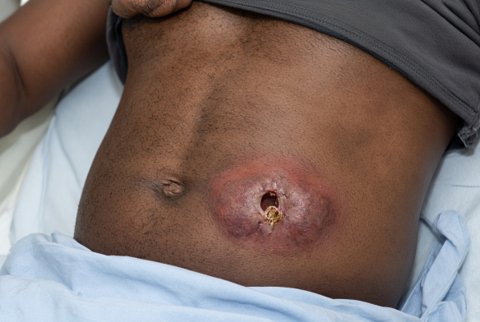











Primary Peritoneal Carcinoma
Primary peritoneal carcinoma is a malignancy of the peritoneum that is histologically indistinguishable from high grade serous ovarian carcinoma. It arises with normal sized or minimally involved ovaries. It occurs almost exclusively in women, with a median age of 60 to 65 years. It accounts for 10 to 15 percent of what was classified as ovarian cancer.
It arises from the peritoneal mesothelium and Müllerian remnants (secondary Müllerian system). It can also arise from the fimbrial end of the fallopian tube (serous tubal intraepithelial carcinoma) that exfoliates onto the peritoneum.
It is linked to BRCA1 and BRCA2 mutations (risk persists after prophylactic bilateral salpingo oophorectomy at about 1 to 4 percent) and to Lynch syndrome.
Pathological criteria:
- Ovaries are normal in size or enlarged by benign process.
- Ovarian involvement is absent or limited to surface (below 5 x 5 mm) or cortical involvement below 5 x 5 mm.
- The histology is serous.
Presentation is at an advanced stage (stage III to IV) in over 90 percent, with peritoneal carcinomatosis, ascites and omental cake.
