












Acromegaly
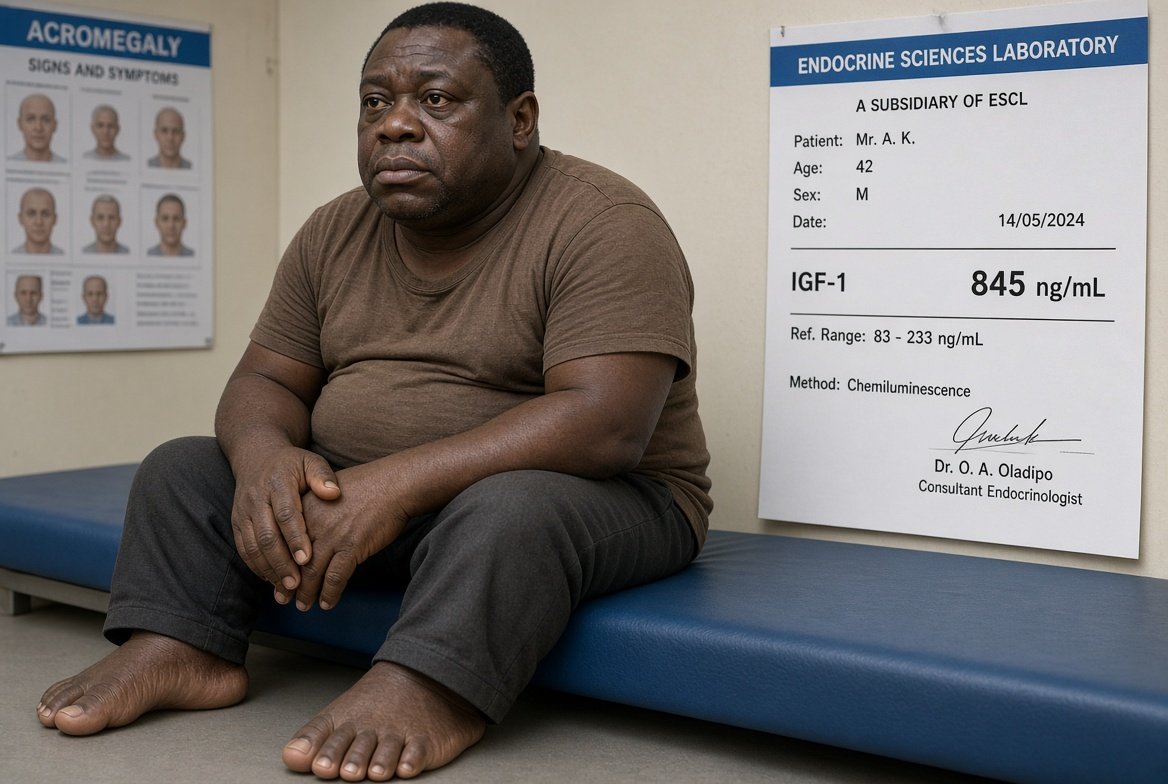
Acromegaly is a chronic disorder of growth hormone (GH) excess, with secondary elevation of insulin like growth factor 1 (IGF-1). In over 95% the cause is a GH-secreting pituitary adenoma (somatotroph adenoma; about 70% macroadenomas at diagnosis).
Rare causes include ectopic GHRH secretion from a neuroendocrine tumour (carcinoid of the lung or pancreas), ectopic GH secretion, and hypothalamic tumour (gangliocytoma).
Familial syndromes include:
- multiple endocrine neoplasia type 1
- McCune-Albright syndrome
- Carney complex
- familial isolated pituitary adenoma (AIP mutation, often presenting in young patients with large, aggressive tumours)
- X-linked acrogigantism (GPR101 duplication)
In children, GH excess before epiphyseal closure causes pituitary gigantism.
Prevalence is about 60 per million, and incidence about 3 to 4 per million per year. The mean age at diagnosis is about 40 to 45 years, with a delay of 5 to 10 years from onset of symptoms. Mortality is increased about 2-fold, mainly from cardiovascular disease, respiratory disease, and cancer, and normalisation of GH and IGF-1 restores near normal life expectancy.
Somatic changes:
- Acral enlargement: increasing ring, glove, and shoe size, thick spade like hands and heel pad thickness above 22 mm
- Facial changes: frontal bossing, prominent supraorbital ridges, enlarged nose, thick lips, prognathism with jaw malocclusion and widely spaced teeth, macroglossia
- Soft tissue thickening and oedema, coarse skin, increased sweating (about 80%), skin tags, acanthosis nigricans, oily skin, and hypertrichosis
- Voice deepening due to enlarged vocal cords and sinuses
- Arthropathy (about 70%): arthralgia, osteoarthritis, carpal tunnel syndrome (30 to 50%), and back pain from vertebral changes
Metabolic and systemic:
- Hypertension (about 30 to 40%), left ventricular hypertrophy, acromegalic cardiomyopathy, diastolic dysfunction, arrhythmias, and heart failure
- Glucose intolerance (about 50%) and diabetes (20 to 30%), from insulin resistance
- Obstructive sleep apnoea (about 60 to 70%), which is also central in some
- Colonic polyps and increased risk of colorectal cancer, and increased thyroid nodules and goitre
- Menstrual irregularity, galactorrhoea, and infertility in women; decreased libido and erectile dysfunction in men (hypogonadism and hyperprolactinaemia from pituitary stalk compression or co-secretion)
- Hypopituitarism from tumour compression
- Fatigue, headaches, and, with larger tumours, visual field defects (bitemporal hemianopia) and cranial nerve palsies
- Reduced quality of life, depression, and increased fracture risk (vertebral fractures despite normal bone density)
- Serum IGF-1: elevated for age and sex, which is the best screening test. Interpret against age and sex matched reference ranges; false results with malnutrition, liver disease, poorly controlled diabetes, hypothyroidism, oestrogen therapy, and pregnancy.
- Confirmatory test: 75 g oral glucose tolerance test with GH measurement at 0, 30, 60, 90, and 120 minutes. A nadir GH level above 1 microgram/L (above 0.4 microgram/L using ultrasensitive assays) confirms the diagnosis; a paradoxical increase is possible.
- The test is not reliable in diabetes, liver or renal failure, and in adolescents, but is useful in most patients. Random GH is not diagnostic because of pulsatile secretion.
- MRI of the pituitary with gadolinium: identify the adenoma, size (micro or macroadenoma), cavernous sinus invasion (Knosp grade), and chiasmal compression. If MRI is negative or normal, measure plasma GHRH and chest and abdominal CT or PET (DOTATATE) to find an ectopic source.
- Pituitary function: prolactin, TSH and free T4, morning cortisol (with ACTH stimulation if indicated), LH, FSH, testosterone or oestradiol.
- Visual field testing (Goldmann or Humphrey) and acuity if macroadenoma abuts the chiasm.
- Complication screening: blood pressure, ECG and echocardiography, fasting glucose and HbA1c, lipids, sleep study, colonoscopy at diagnosis (repeat every 3 to 5 years depending on findings, or every 5 years if normal), thyroid ultrasound if palpable, bone density and spine imaging as indicated.
- Genetic testing and family screening in young patients (under 30 years), macroadenomas in the young, gigantism, or familial disease (AIP, MEN1).
Goals: normalise IGF-1 (age and sex adjusted) and random GH below 1 microgram/L (some use below 2.5 micrograms/L in older definitions) or nadir GH under 0.4 microgram/L after glucose, control tumour mass, relieve compressive symptoms, treat comorbidities, and preserve pituitary function.
First line: transsphenoidal surgery (endoscopic or microscopic) by an experienced pituitary surgeon. Remission in about 80 to 90% of microadenomas and 40 to 60% of macroadenomas (lower with cavernous sinus invasion, around 20 to 30%). Debulking improves the response to medication, even when not curative.
Complications: transient diabetes insipidus (about 10 to 30%, permanent about 2 to 5%), CSF leak (about 2 to 4%), hypopituitarism (about 5 to 15% new), meningitis, and rare visual or vascular injury. Reassess at 12 weeks post-operatively with IGF-1 and an oral glucose tolerance test; check pituitary function and cortisol (peri operative hydrocortisone cover).
Medical therapy (when surgery is not curative or not suitable, or as pre-operative therapy in selected patients):
- First generation somatostatin receptor ligands: octreotide LAR 20 mg intramuscularly every 4 weeks (range 10 to 40 mg), lanreotide autogel 90 to 120 mg deep subcutaneously every 4 to 8 weeks (up to every 4 weeks). They achieve biochemical control in about 30 to 55% and tumour shrinkage in about 50%.
- Oral octreotide capsules 40 to 80 mg daily in two divided doses are an option for patients who respond to injectable analogues.
- Adverse effects of somatostatin receptor ligands: gastrointestinal upset, steatorrhoea, gallstones and sludge (about 25%), hyperglycaemia, and bradycardia
- Pasireotide LAR 40 to 60 mg intramuscularly every 4 weeks (second generation, for patients not controlled by first generation drugs); higher risk of hyperglycaemia (about 60 to 70% with glucose rises; monitor and manage diabetes proactively, with GLP-1 agonist or DPP-4 inhibitor as first choice)
- Pegvisomant (growth hormone receptor antagonist): 80 mg subcutaneous loading dose, then 10 mg daily (titrate by 5 mg every 4 to 6 weeks to a maximum of 30 mg daily, some give up to 40 mg).
- Guide dosing by IGF-1 (GH levels are not useful during pegvisomant).
- Pegvisomant normalises IGF-1 in over 90% at adequate doses, either alone or combined with somatostatin analogues (weekly pegvisomant 40 to 80 mg).
- Monitor liver enzymes (transaminase rises in about 2 to 5%) at 4 to 6 weeks for the first 6 months, and monitor for lipohypertrophy at injection sites. Tumour size should be followed by MRI
- Cabergoline 0.5 to 3.5 mg weekly in two divided doses (mild disease with IGF-1 less than 2.5 times the upper limit, or co-secretion of prolactin), controlling about 30%.
- Monitor for valvular heart disease with cabergoline at high doses
Radiotherapy. Conventional fractionated radiotherapy (45 to 50 Gy in 25 to 28 fractions) or stereotactic radiosurgery (Gamma Knife, 20 to 25 Gy to the tumour margin) for residual tumour after surgery or failing medical therapy. Biochemical control takes years (5 to 15 years with conventional radiotherapy, 3 to 5 years with SRS), requires continued medical therapy in the meantime, and leads to hypopituitarism in 30 to 50% in 10 years. Other late risks: cranial neuropathy, secondary tumours, and cerebrovascular disease.
Comorbidities and follow up. Control blood pressure (ACE inhibitor or ARB), treat diabetes, treat sleep apnoea (continuous positive airway pressure), replace deficient pituitary hormones (hydrocortisone, levothyroxine, sex steroids), colonoscopy surveillance, and carpal tunnel decompression as needed. IGF-1 and GH every 3 to 6 months initially, then every 6 to 12 months, annual pituitary imaging and pituitary function. Long term care in a multidisciplinary pituitary centre.
