












Aortic Dissection
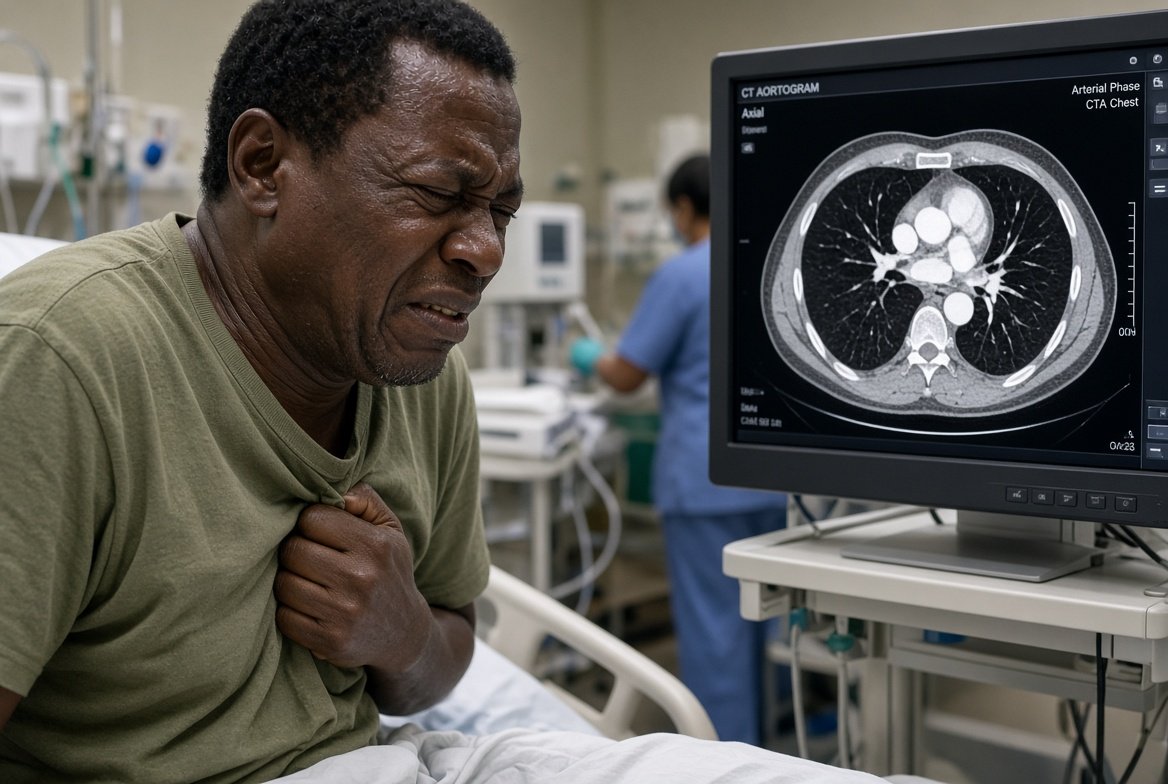
Aortic dissection is a tear in the aortic intima that allows blood to enter the media, creating a false lumen that propagates along the aorta. It is the commonest catastrophic aortic emergency, with an incidence of 3 to 6 per 100,000 per year. Without treatment, mortality in acute type A dissection rises by 1 to 2% per hour in the first 48 hours, reaching over 50% at 1 week.
Classification
- Stanford type A: involves the ascending aorta, regardless of origin of the tear. Surgical emergency.
- Stanford type B: confined to the descending aorta distal to the left subclavian artery.
- DeBakey: type I (ascending to arch and beyond), type II (ascending only), type III (descending only: IIIa above the diaphragm, IIIb extending below).
- Timing: hyperacute (under 24 hours), acute (up to 14 days), subacute (15 to 90 days), chronic (over 90 days).
- Related acute aortic syndromes: intramural haematoma (haemorrhage in the wall without intimal tear) and penetrating atherosclerotic ulcer.
Risk factors
- Hypertension (in about 70%).
- Age 60 to 70 years, male sex (about 2:1).
- Connective tissue disease: Marfan, Loeys-Dietz, vascular Ehlers-Danlos syndrome, Turner syndrome, familial thoracic aortic aneurysm and dissection.
- Bicuspid aortic valve, coarctation, pre-existing aneurysm, aortitis (giant cell arteritis, Takayasu arteritis, syphilis).
- Cocaine and amphetamine use, fluoroquinolone exposure, heavy weightlifting.
- Pregnancy (third trimester and postpartum), especially with Marfan syndrome.
- Iatrogenic: cardiac catheterisation, cardiac surgery, aortic cross-clamping, intra-aortic balloon pump, aortic valve interventions.
- Trauma: deceleration injuries.
Complications determining prognosis
- Aortic regurgitation, coronary malperfusion (right coronary mostly), pericardial tamponade and rupture (type A).
- Branch malperfusion (cerebral, spinal cord, mesenteric, renal, limb), rupture, and aneurysmal degeneration of the false lumen in the chronic phase.
- Hospital mortality of medically managed acute type B dissection is 10%, and with complications (malperfusion, rupture) is 20% or more. Surgical mortality in type A is 15 to 25%.
