












Arterial Leg Ulcer
Also known as: Ischaemic Ulcer
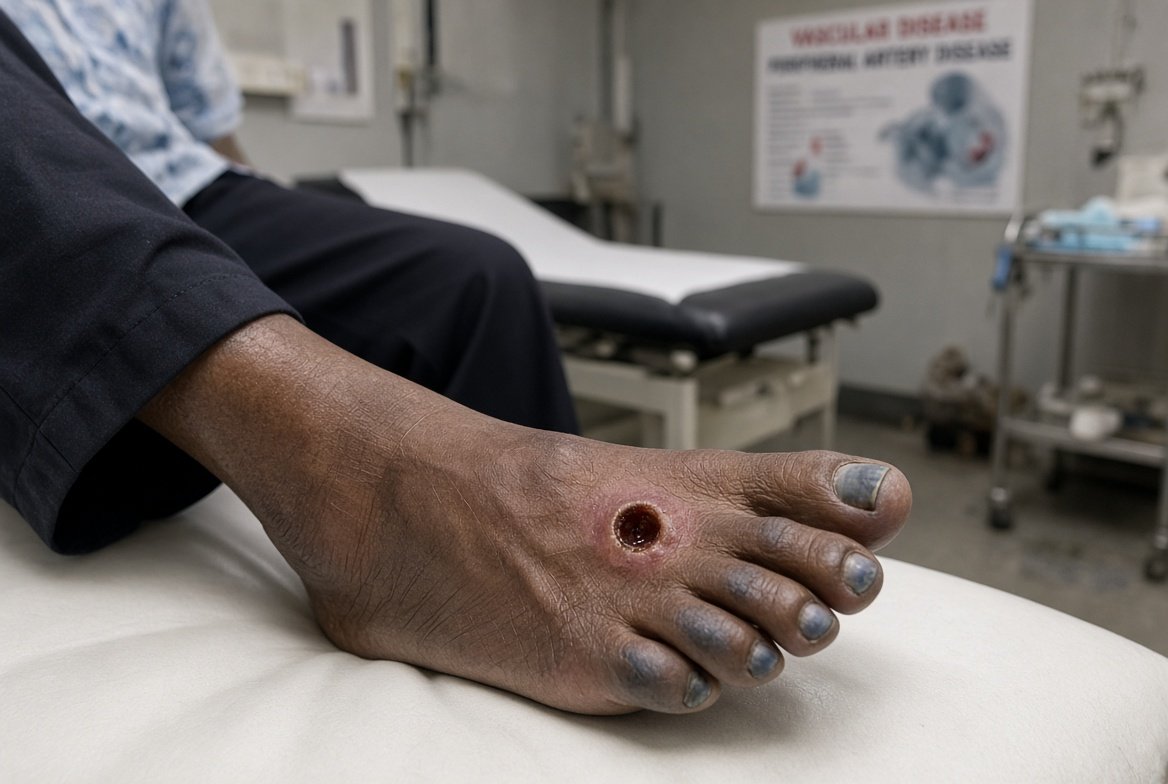
Ulceration caused by inadequate arterial supply to the leg and foot, from atherosclerotic peripheral arterial disease (the commonest cause), and less often thromboangiitis obliterans (Buerger disease), vasculitis, embolism, or arterial calcification.
- It accounts for about 10 to 25% of leg ulcers. It signals chronic limb threatening ischaemia when it occurs with rest pain, and carries a 1-year amputation risk of 10 to 40% without revascularisation and a 5-year mortality of about 40 to 60%, because of coexisting coronary and cerebrovascular disease.
- Risk factors: smoking (the most important), diabetes, hypertension, hyperlipidaemia, chronic kidney disease, older age, family history, and inflammatory disease.
- Typical sites: pressure points and sites of minor trauma on the toes, heel, malleoli, shin and the dorsum of the foot. Trauma from ill fitting shoes, injury and compression bandages applied to ischaemic limbs is often the final trigger.
- Poor healing results from low perfusion pressure, so even small wounds enlarge and become infected.
- Punched out, deep, well demarcated ulcer with a dry, pale, necrotic, or sloughy base, little granulation tissue and little exudate, on the toes, heel, foot margins, or lateral leg.
- Pain is severe, worse at night and when the leg is raised, and eased by hanging the leg out of bed (dependent). Intermittent claudication in the calf, thigh or buttock may precede ulceration.
- The limb is cold, pale, shiny and hairless, with thickened nails, dependent rubor, delayed capillary refill (more than 3 seconds), elevation pallor (Buerger test: pallor on raising the leg to 45 degrees for 1 to 2 minutes, then rubor on hanging), and absent or weak foot pulses. Femoral bruits may be heard.
- Dry gangrene of toes appears in advanced disease, with wet gangrene and cellulitis if infected.
- Differential diagnosis: venous ulcer, diabetic neuropathic ulcer, vasculitic ulcer, pyoderma gangrenosum, calciphylaxis (renal failure), cholesterol emboli (blue toes), pressure ulcer, Martorell hypertensive ischaemic ulcer (painful, lateral leg, in hypertension), malignant ulcer and infective ulcer.
- Red flags: rest pain, gangrene, cold limb, sudden onset of severe pain with pallor, paraesthesia and weakness (acute limb ischaemia, an emergency needing revascularisation within 6 hours), spreading infection, and systemic sepsis.
- Complications: infection, osteomyelitis, gangrene, sepsis, amputation, myocardial infarction, stroke and death.
- Palpate femoral, popliteal, dorsalis pedis and posterior tibial pulses. Record temperature, colour, capillary refill, sensation, and ulcer depth.
- Ankle brachial pressure index with a hand held Doppler: normal 1.0 to 1.4, mild disease 0.7 to 0.9, moderate 0.4 to 0.7, severe below 0.4. A value above 1.3 indicates calcified incompressible vessels (common in diabetes and renal failure), so measure toe pressure and toe brachial index (toe pressure below 30 mmHg predicts poor healing, and below 50 mmHg with a toe brachial index below 0.7 is abnormal), or use transcutaneous oxygen pressure (below 30 mmHg predicts non-healing).
- Duplex ultrasound of the arterial tree to locate stenoses and occlusions.
- Imaging for revascularisation planning: CT angiography or magnetic resonance angiography, or digital subtraction angiography with the possibility of immediate endovascular treatment. Check creatinine and weigh the contrast risk in renal impairment.
- Blood tests: full blood count, glucose and HbA1c, lipids, creatinine and eGFR, CRP, and, for young patients or an atypical picture, thrombophilia, vasculitis screen, and tests for cholesterol embolism and Buerger disease.
- Swab infected wounds, take blood cultures if febrile, and image the foot for bone involvement. Electrocardiogram and cardiac risk assessment before intervention.
- Urgent vascular assessment (within 24 to 72 hours) for any suspected arterial ulcer, or immediately for acute ischaemia, rest pain, gangrene or infection. Revascularisation is the only way to heal an ischaemic ulcer.
- Acute limb ischaemia (an emergency): start unfractionated heparin 5000 units IV bolus (or 80 units/kg) then infusion to maintain an activated partial thromboplastin time of 1.5 to 2.5 times normal, give analgesia, and arrange immediate imaging and embolectomy, thrombolysis or bypass within hours.
- Revascularisation, tailored to anatomy and fitness:
- Endovascular: balloon angioplasty, drug coated balloons, stenting, or atherectomy.
- Open surgery: bypass (with autologous vein where possible), endarterectomy, or hybrid procedures.
- Success depends on the level of disease. Wound healing after revascularisation occurs in about 60 to 80% over weeks to months.
- Amputation is considered for extensive necrosis, uncontrollable infection, intractable rest pain not amenable to revascularisation, or a non-functional limb, after multidisciplinary discussion.
- Medical therapy for all patients (reduces limb and cardiovascular events):
- Antiplatelet: aspirin 75 to 100 mg daily, or clopidogrel 75 mg daily. After revascularisation, dual therapy is given for 1 to 6 months, or low dose rivaroxaban 2.5 mg 12 hourly with aspirin 100 mg daily, in selected patients with low bleeding risk.
- Statin: atorvastatin 40 to 80 mg daily (or rosuvastatin 20 to 40 mg), aiming for LDL cholesterol below 1.4 mmol/L (55 mg/dL), adding ezetimibe 10 mg daily when needed.
- Blood pressure control to below 140/90 mmHg (below 130/80 mmHg in diabetes), with an ACE inhibitor such as ramipril 5 to 10 mg daily. Beta blockers are not contraindicated in peripheral arterial disease.
- Diabetes control: HbA1c about 53 mmol/mol (7%), and review for SGLT2 inhibitors or GLP-1 agonists with cardiovascular benefit. Take care with SGLT2 inhibitors in active ischaemia and foot ulceration, because of amputation risk concerns with some agents.
- Complete smoking cessation (counselling, nicotine replacement, varenicline 0.5 mg daily increasing to 1 mg 12 hourly for 12 weeks).
- Supervised exercise therapy for claudication (3 sessions weekly for 3 months, walking to near maximal pain), after the ulcer has healed or when limb viability is secure.
- Cilostazol 100 mg orally 12 hourly for claudication symptoms (not for ulceration), contraindicated in heart failure of any grade.
- Wound care (conservative, while awaiting or after revascularisation):
- No compression, because it can precipitate ischaemia.
- Keep dry gangrene dry and stable (povidone iodine 10% paint, dry dressings), because wet necrosis is dangerous.
- Do not perform aggressive sharp debridement of dry, ischaemic tissue until perfusion is restored. Apply non-adherent, low trauma dressings, and use hydrogel only on viable tissue.
- Off load the heel and foot with pressure relieving footwear and heel protectors. Keep the leg level or slightly dependent at night, but avoid prolonged dependency causing oedema. Do not elevate the limb.
- Protect from trauma and maintain warmth with loose, non-compressive padding.
- Infection: start prompt antibiotics in ischaemic wounds, since infection can cause rapid tissue loss.
- Mild: amoxicillin clavulanate 875/125 mg orally 12 hourly for 7 to 14 days.
- Moderate to severe: piperacillin tazobactam 4.5 g IV 6 to 8 hourly, with vancomycin 15 to 20 mg/kg IV 8 to 12 hourly adjusted to levels if MRSA is likely, or meropenem 1 g IV 8 hourly, adjusted to renal function, with urgent surgical drainage or debridement of abscess and wet necrosis.
- Osteomyelitis: 4 to 6 weeks of therapy after bone resection, or longer without surgery.
- Pain: regular paracetamol 1 g 6 hourly, with opioids (morphine 5 to 10 mg orally 4 hourly or modified release equivalent) and a neuropathic agent (gabapentin 300 mg at night, titrated to 900 to 1800 mg daily) for rest pain, while revascularisation is arranged. Spinal cord stimulation or lumbar sympathectomy are options for unreconstructable disease, and prostanoid infusion (iloprost 0.5 to 2 nanograms/kg/min for 6 hours daily for 1 to 4 weeks, where available) has a limited role.
- Special groups:
- Diabetes: needs combined vascular and diabetic foot care, since neuropathy, infection and ischaemia coexist.
- Renal failure: use ultrasound or low contrast angiography, and consider calciphylaxis in the dialysis patient with painful skin necrosis.
- Elderly and frail: align the treatment goals with the patient's wishes, with palliative input where revascularisation is not possible.
- Young patients: think of Buerger disease (stop smoking completely, which is the only effective treatment), vasculitis and thrombophilia.
- Follow up: review weekly in a multidisciplinary foot or limb salvage clinic until healed, with repeat ankle brachial index or toe pressure after revascularisation, and graft surveillance duplex at 1, 3, 6 and 12 months, then annually. Refer all arterial ulcers urgently to vascular surgery.
