
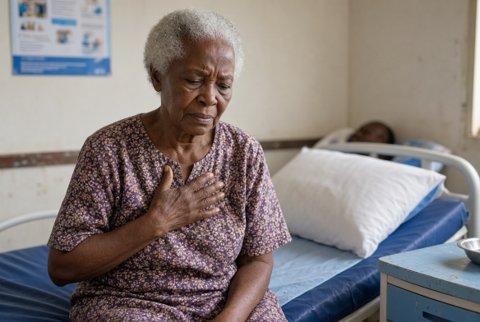











Asbestos-Related Lung Cancer
Also known as: Asbestos Lung Cancer
Asbestos related lung cancer is primary lung carcinoma caused or contributed to by asbestos exposure. It occurs with or without asbestosis, and risk rises with cumulative dose.
Epidemiology. All fibre types increase risk, with amphiboles more potent than chrysotile. Risk is greatest in smokers, in whom asbestos and tobacco effects combine multiplicatively or close to it.
Latency. Usually 10 to 30 years or more after first exposure.
Attribution. Causation is accepted when exposure is substantial; a doubling of risk and radiographic or pathological asbestosis are commonly used markers. Exposure thresholds vary between jurisdictions.
Histology. All types occur; adenocarcinoma and squamous cell carcinoma are most frequent.
Pathophysiology.
Fibres cause chronic inflammation, reactive oxygen and nitrogen species generation and DNA damage. Fibre associated macrophage activation and cytokine release promote epithelial transformation.
Asbestos also carries carcinogenic contaminants and absorbs tobacco carcinogens on its surface, contributing to the synergy with smoking.
