











Glucocorticoid Resistance Syndrome
Glucocorticoid resistance syndrome (Chrousos syndrome) is a rare disorder of reduced tissue sensitivity to cortisol, caused by variants in the glucocorticoid receptor gene (NR3C1). It is usually autosomal dominant, with a few recessive cases.
Reduced receptor function weakens negative feedback, so ACTH and cortisol rise, with excess adrenal androgens and mineralocorticoids. The patient has no Cushingoid features despite high cortisol.
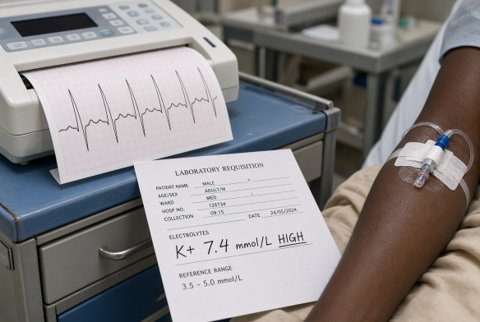
Severity varies from asymptomatic (found by chance) to severe, with hypertension, hypokalaemia and hyperandrogenism.
Pathophysiology.
Variants reduce receptor number, ligand binding, nuclear translocation or gene regulation. The hypothalamic-pituitary-adrenal axis then sets a higher cortisol level to compensate.
High ACTH drives adrenal androgens and deoxycorticosterone and corticosterone, which act on the mineralocorticoid receptor to cause hypertension and hypokalaemia.
