








Pityriasis Lichenoides et Varioliformis Acuta
Also known as: PLEVA, Mucha-Habermann Disease
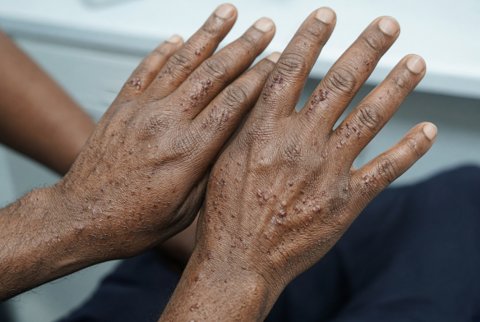
Pityriasis lichenoides et varioliformis acuta is an acute, self-limited eruption of crops of erythematous papules that evolve to vesicles, pustules and haemorrhagic, necrotic crusts. Lesions heal with varioliform (smallpox like) scars and pigment change.
It affects children and young adults, with a slight male predominance, and may follow infection. A severe febrile ulceronecrotic variant with large confluent necrotic ulcers and high fever is rare.
Proposed triggers are infections (Epstein-Barr virus, parvovirus B19, Toxoplasma gondii, HIV) and drugs, and the condition is regarded as a T-cell mediated vascular reaction. It runs a course of weeks to months, with spontaneous resolution in most cases.
Pathophysiology.
A cytotoxic T-cell reaction produces lymphocytic vasculitis with endothelial damage, keratinocyte necrosis and extravasation of red cells. The infiltrate is wedge shaped and dense, with CD8 positive cells predominating. Clonal T-cell receptor rearrangement is found in some cases.
