
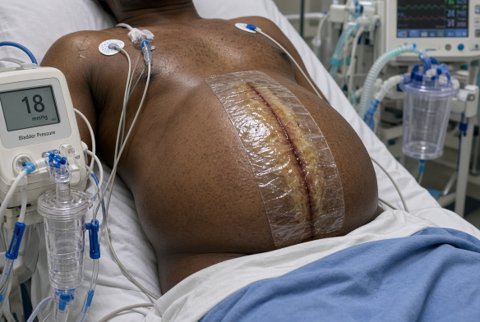











Traumatic Pericardial Rupture
Traumatic pericardial rupture is a tear of the pericardium from blunt or penetrating trauma. It may lead to herniation of the heart through the defect, with obstruction to venous return and sudden collapse.
Epidemiology. It is rare and found in under 1% of blunt chest trauma. Most cases are found at operation or autopsy. Mortality is about 40% in reported series, mostly from associated injuries.
Mechanisms. Severe blunt force from road traffic collision or crush, sudden rise in intrathoracic or intra-abdominal pressure, and penetrating injury. Left sided tears are more frequent (about 65%) and are often combined with a rupture of the left pleura. Right sided tears and diaphragmatic tears can also occur.
Pathophysiology. Through a large defect the heart can herniate into the pleural cavity, with torsion of great vessels, strangulation of the ventricles, obstruction of the venous return and cardiac output, and arrhythmia. Small defects can strangulate a part of the ventricle. Usually pericardial fluid and blood drain to the pleural cavity, which reduces the risk of tamponade.
